
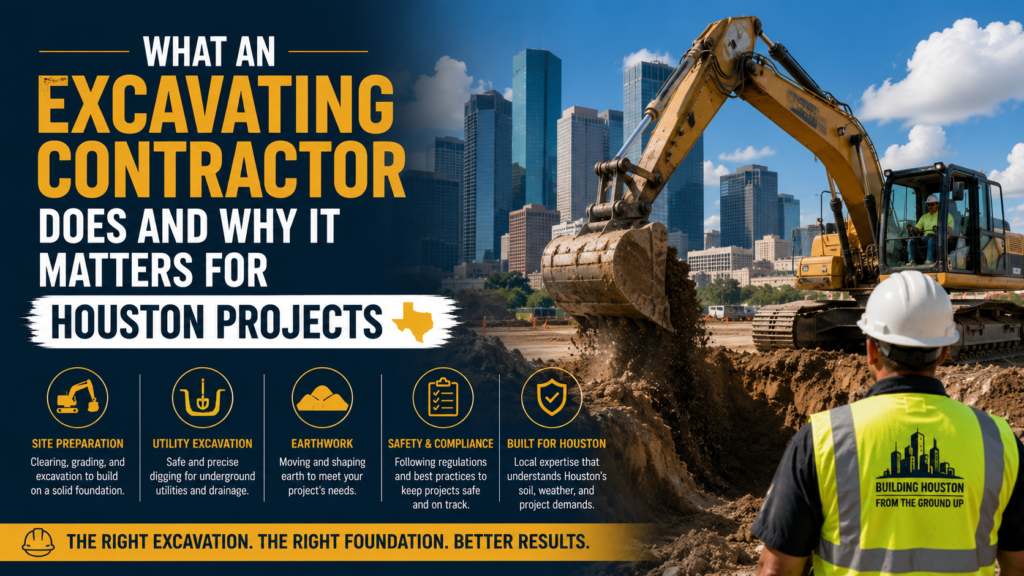
Every construction project that involves the ground begins with excavation. Whether it is a new home foundation on a cleared suburban lot, a commercial building in the heart of Houston’s business district, a drainage correction system for a flood-prone residential property, or an underground utility line serving a new development, excavation is the essential first step. Understanding what an Excavating Contractor Houston does, the methods and equipment they use, and why Houston’s specific conditions make local expertise indispensable will help any property owner or developer approach an excavation project with the knowledge needed to make good decisions.
What Is Excavation?
Excavation is the process of removing earth, rock, or other material from a site to create the space or conditions required for a construction project. It is broader than simply digging a hole it encompasses land clearing, grading, trenching, soil compaction, drainage work, and the management of excavated material, all of which must be performed in a specific sequence and to specific tolerances for the work to support the construction that follows.
An excavating contractor is the professional responsible for planning and executing these earthwork operations. They assess site conditions, determine the appropriate methods and equipment, manage the safety of the work, and deliver a finished site that meets the engineering specifications required for the next phase of construction.
Types of Excavation Work
Topsoil Excavation involves removing the uppermost layer of earth, which typically contains organic material, plant roots, and moisture that make it unsuitable as a stable base for construction. Removing topsoil is usually the first physical step in preparing a site for any structure, and it must be done before deeper excavation or grading begins.
Earth Excavation goes deeper than topsoil removal, reaching into the underlying soil layers to establish the depth required for foundations, basements, underground utilities, or other below-grade construction. The soil encountered at these depths is typically more stable than topsoil, but its composition sandy, loamy, clay-heavy, or mixed affects how it can be compacted and built upon. In Houston, where expansive clay soils are extremely common, understanding the behavior of the underlying earth is essential to proper foundation excavation.
Rock Excavation is the most technically demanding type, requiring specialized equipment such as hydraulic breakers, chisels, and in some cases controlled blasting. While Houston’s relatively flat coastal terrain means solid rock is less common than in more geological complex parts of Texas, caliche a hardened calcium carbonate layer that can occur at various depths is sometimes encountered and requires specialized removal techniques.
Trenching refers to excavating narrow, deep channels, typically for the installation of underground utilities including water lines, sewer lines, gas lines, electrical conduits, and drainage structures. Trenching is a specialized skill that requires strict adherence to OSHA’s excavation safety standards, particularly regarding the protection of workers from trench cave-ins through proper shoring, sloping, or benching of trench walls.
Mass Excavation involves removing large volumes of earth from a site to achieve a target elevation or grade across a broad area. This is common on large commercial and residential development sites where the natural terrain must be reshaped to match engineering plans. Mass excavation generates substantial quantities of excavated material that must be either redistributed on site or hauled off to appropriate disposal or fill locations.
Grading: Making the Earth Work for Construction
Grading the process of shaping the excavated earth to achieve specific slopes, elevations, and contours is closely related to excavation and is typically performed by the same contractor as part of site preparation. Proper grading serves two critical functions. First, it creates the level, compacted base needed for foundations, slabs, and paving. Second, it establishes the drainage patterns that direct water away from structures rather than toward them.
In Houston, where annual rainfall is substantial and the flat terrain means that water has limited natural places to go, grading is especially important. Poor grading that allows water to pond near a foundation can lead to soil erosion, foundation settlement, and flooding of the structure itself. An experienced excavating contractor in Houston designs and executes grading plans with an understanding of local drainage patterns, soil behavior under saturation, and the requirements of the City of Houston’s drainage and stormwater regulations.
Houston Soil Conditions and Excavation
Houston’s soil primarily expansive black clay known locally as “gumbo” presents unique challenges for excavation and site preparation. Expansive clay soils shrink dramatically when dry and swell when wet, creating movement in the ground that can affect foundations, underground utilities, and any other structure built upon or within them. In some areas of Houston, this soil movement is a primary cause of foundation problems.
An excavating contractor working in Houston must account for these soil characteristics in their approach. Soil testing before excavation helps identify the composition and behavior of the earth at a given site, informing decisions about excavation depth, foundation type, compaction requirements, and moisture management during and after construction. Proper compaction of backfill material after utilities are installed or foundations are poured is critical to preventing settlement that could damage structures over time.
In some cases, Houston’s clay soils require the import of engineered fill material typically crushed concrete or sandy loam to provide a stable base for construction where the native soil alone is insufficient. Managing this process sourcing appropriate fill, placing it in lifts, and compacting each lift to the required density is part of the excavating contractor’s scope of work on many Houston projects.
Utility Coordination and Safety
One of the most critical safety requirements before any excavation begins is contacting Texas 811, the state’s one-call notification system, to have all underground utilities located and marked on the job site. Houston’s dense network of underground utilities water, sewer, gas, electric, telecommunications, and fiber makes this step non-negotiable. Striking an underground utility line during excavation can cause severe injuries, significant property damage, and costly service disruptions. A professional excavating contractor ensures that the 811 call is made well in advance of any digging and that all utility markings are observed and respected throughout the excavation process.
OSHA’s excavation and trenching standards (29 CFR 1926 Subpart P) establish specific requirements for worker protection in excavations, including the classification of soil type, the use of protective systems in trenches deeper than five feet, and the requirements for access and egress from excavated areas. A professional excavating contractor operates in full compliance with these standards on every job.
Equipment Used in Excavation
Excavating contractors use a range of heavy equipment selected based on the scale and nature of the work. Excavators (also called track hoes) are the most versatile and commonly used machines, capable of digging, grading, loading, and placing material with a variety of attachments. Bulldozers are used for moving large volumes of material and rough grading across broad areas. Backhoes combine a digging bucket on the rear with a loader bucket on the front, making them useful for trenching and material handling on smaller sites. Compactors including vibratory plate compactors and roller compactors are used to compact soil and fill to the density required by engineering specifications. Dump trucks haul excavated material to disposal or fill sites.
A contractor with a well-maintained fleet of owned equipment can mobilize efficiently, adapt to changing site conditions, and complete work on schedule without the delays and premium costs associated with last-minute equipment rentals.
Final Thoughts
Excavation is the essential foundation of any construction project that touches the ground. In Houston, where expansive clay soils, high rainfall, flat terrain, and dense underground utility networks create a distinct set of challenges, excavation work demands local expertise, proper equipment, and strict adherence to safety standards. An experienced excavating contractor brings all of these qualities to every project, ensuring that the most critical preparatory work is done right providing a stable, properly graded, and safely prepared site for whatever comes next.