La Sierra is one of the most dynamic and historically rich neighborhoods in the City of Riverside, California. Named after the original Mexican land grant known as Rancho La Sierra de Sepulveda, the area was once its own independent community before being annexed by the City of Riverside in 1964. Today, La Sierra serves as the western gateway to Riverside, stretching between the city’s western edge and the Arlington area. The neighborhood encompasses a remarkable diversity of land uses from La Sierra University’s 140-acre campus to the retail corridors at the Galleria at Tyler, Kaiser Hospital, business parks, apartment communities, and single-family residential neighborhoods that range from conventional subdivisions to gated planned developments.
La Sierra’s growth accelerated dramatically in the late 1990s and early 2000s when the Riverwalk master-planned community brought more than 1,000 new single-family homes and over 500 luxury apartments to the neighborhood. The La Sierra Metrolink Station provides rail connectivity to Los Angeles and Orange County. This blend of residential, commercial, institutional, and transit-oriented development creates sustained and diverse demand for professional asphalt paving services throughout the community.
What Is an Asphalt Contractor and What Do They Do?
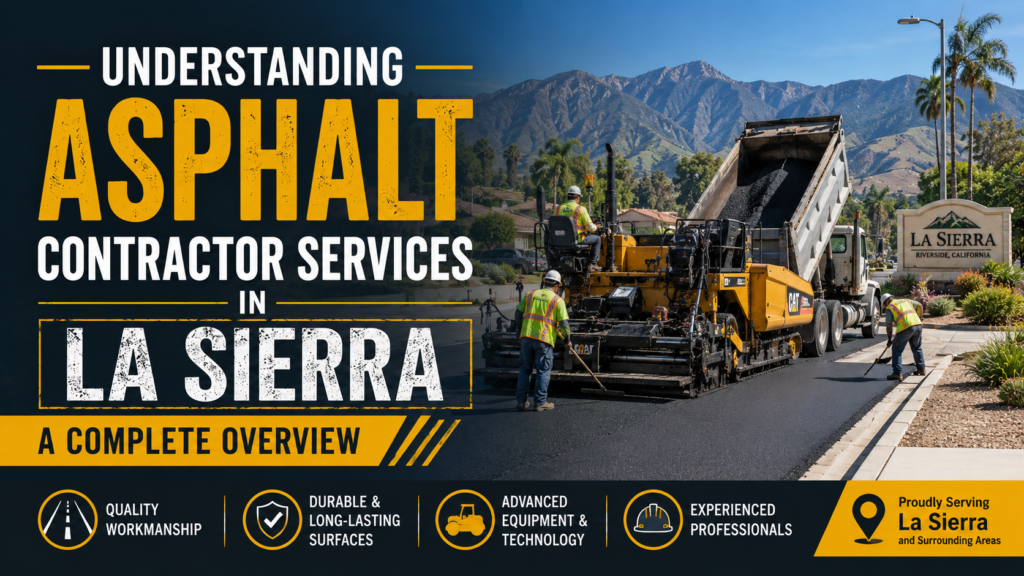
An Asphalt Contractor La Sierra is a licensed professional who specializes in the installation, repair, and maintenance of asphalt pavement surfaces. This includes driveways, parking lots, roadways, pathways, and commercial aprons. Asphalt also known as bituminous concrete or blacktop is a composite material made from aggregates (crushed stone, gravel, and sand) bound together with a petroleum-based binder called bitumen. Its combination of durability, flexibility, cost-effectiveness, and relatively fast installation time makes it the most widely used paving material for roadways and parking areas in the United States.
In La Sierra and across Riverside County, asphalt contractors serve a diverse clientele: residential homeowners, commercial property managers, homeowners’ associations (HOAs), schools and universities, retail centers, industrial properties, and municipal agencies. Each type of client presents different paving needs a homeowner needs a smooth, aesthetically appealing driveway, while a commercial property manager needs a well-marked parking lot that can withstand heavy vehicle traffic over many years.
Types of Asphalt Paving Services
New Asphalt Installation: When a surface does not yet have paving a newly constructed home, a freshly developed commercial lot, or a gravel area being upgraded asphalt contractors perform full installation. This process begins with site preparation: grading the surface to ensure proper drainage, compacting the sub-base to provide a stable foundation, and then laying a base course of asphalt followed by the surface course. Proper compaction at each stage is essential for longevity. A well-installed asphalt surface can last 20 to 25 years or more with appropriate maintenance.
Asphalt Resurfacing and Overlay: When an existing asphalt surface has deteriorated but the underlying base remains structurally sound, asphalt contractors can apply an overlay a new layer of hot-mix asphalt over the existing surface. This process is more economical than full replacement and typically extends the pavement’s life by 7 to 12 years. Before an overlay is applied, the contractor typically levels any sunken or damaged areas and mills or grinds rough transitions to ensure a smooth finished surface.
Full Removal and Replacement: When asphalt has deteriorated to the point where the base is compromised evidenced by widespread cracking, severe rutting, significant alligatoring, or structural failure the appropriate remedy is full removal and replacement. The contractor excavates the failed material, inspects and if necessary repairs or replaces the base, and installs new asphalt in layers. This is a more significant investment than overlay but delivers a pavement that performs as new construction.
Crack Sealing and Repair: Cracks in asphalt are not merely cosmetic issues they are pathways for water to penetrate the pavement and undermine the structural base. In Southern California’s climate, where intense UV radiation from year-round sun accelerates oxidation and occasional heavy rain events saturate exposed bases, crack management is critically important. Asphalt contractors apply hot-rubberized crack sealant to fill and seal cracks before they propagate, significantly extending pavement life. Cracks wider than approximately one inch typically require patching with fresh hot-mix asphalt rather than simple sealing.
Sealcoating: Sealcoating is a preventive maintenance treatment applied to asphalt surfaces to protect them from the damaging effects of UV radiation, water infiltration, oxidation, and automotive fluid spills. The sealant a bituminous or acrylic emulsion containing silica sand, polymers, and water is spray-applied or squeegeed onto the pavement surface in one or two passes, restoring the deep black appearance of new asphalt and creating a protective barrier. Sealcoating does not repair cracks or structural damage; it is a maintenance tool that slows deterioration. Most professionals recommend sealcoating every two to five years depending on traffic and climate conditions.
Asphalt Milling: Milling is the mechanical removal of the top layer of an asphalt surface using a rotating drum equipped with carbide teeth. This process is used to remove damaged or worn surface material before an overlay is applied, to reduce pavement elevation at transitions, or to restore drainage patterns that have been lost as pavement accumulates over multiple overlay cycles. The milled material known as reclaimed asphalt pavement (RAP) is typically recycled back into new asphalt mixes, making milling an environmentally responsible practice.
Parking Lot Striping: Line striping is a specialized service closely associated with asphalt paving but sometimes performed by dedicated striping contractors. Parking lot striping including space lines, directional arrows, fire lane markings, crosswalks, and ADA-compliant accessible parking space designations is essential for traffic flow, safety, and legal compliance. In California, ADA parking requirements are strictly enforced, and commercial property owners have significant obligations regarding the number, dimensions, location, and signage of accessible parking spaces.
Why Southern California’s Climate Demands Expert Asphalt Care
La Sierra’s location in the Inland Empire means that asphalt surfaces here face a challenging combination of environmental stressors. Intense UV radiation from Riverside’s 280+ days of sunshine per year accelerates asphalt oxidation, causing the bitumen binder to become brittle and the surface to fade from black to gray. High daytime temperatures regularly exceeding 100°F in summer soften asphalt surfaces and make them more susceptible to rutting under heavy loads. Occasional intense rainfall events, while less frequent than in wetter climates, can cause significant erosion of exposed bases and accelerate subsurface water damage if cracks are left unsealed.
These conditions make a proactive maintenance approach particularly important for La Sierra property owners. Rather than waiting for pavement to deteriorate significantly before taking action, pavement management programs that schedule regular sealcoating, crack sealing, and periodic inspection allow property owners to maximize the lifespan of their investment. Experienced asphalt contractors familiar with Southern California conditions understand how to formulate maintenance plans that account for the specific climate challenges of the Riverside area.
Residential vs. Commercial Asphalt Paving in La Sierra
Residential asphalt paving in La Sierra primarily centers on driveways, although homeowners also occasionally need parking pads, pathway paving, and RV or trailer pads. Residential driveways must balance aesthetics with functionality homeowners in La Sierra’s suburban neighborhoods often have strong preferences about color, finish quality, and edge detailing. Residential projects also involve working in close proximity to landscaping, structures, and neighboring properties, requiring care and precision in layout and execution.
Commercial asphalt paving in La Sierra particularly in areas like the Riverwalk business park and the retail corridors along La Sierra Avenue, Indiana Avenue, and Van Buren Boulevard involves larger-scale projects with more complex requirements. Parking lot layouts must accommodate ADA accessibility, stormwater drainage, fire lane access, curbing, wheel stops, and pedestrian walkways. Commercial properties also experience significantly higher traffic volumes than residential driveways, which demands higher-specification asphalt mixes and base designs to resist rutting and premature deterioration.
HOA communities, which are prevalent throughout La Sierra’s newer master-planned subdivisions, represent a third distinct category. Community roadways and parking areas within HOA communities must be maintained to high standards consistent with community appearance requirements, and resurfacing or repair work must be planned to minimize disruption to multiple households. Asphalt contractors experienced with HOA projects understand how to manage community communication, phased work scheduling, and ADA compliance for shared community infrastructure.
The Importance of Proper Sub-Base Preparation
One of the most important factors in asphalt performance and one that is invisible once the pavement is laid is the quality of the sub-base beneath it. A sub-base that is poorly compacted, inadequately deep, or compromised by unstable soils will cause even well-installed asphalt to crack, rut, or sink prematurely. In La Sierra and across the Inland Empire, soil conditions vary, and contractors must assess each site’s sub-base requirements individually. Areas with expansive clay soils, fill material, or weak native soils may require deeper base courses, soil stabilization treatments, or other interventions before paving.
Experienced asphalt contractors conduct site assessments before proposing a paving solution, evaluating existing pavement condition, sub-base stability, drainage patterns, and traffic loading. This assessment informs an appropriate specification for base depth and asphalt thickness specifications that may differ significantly from project to project even within the same neighborhood.
Sustainable Asphalt Practices and Material Recycling
Asphalt is one of the most recycled materials in the construction industry. Reclaimed asphalt pavement (RAP) recovered through milling and full-depth removal can be processed and incorporated into new asphalt mixes as a partial substitute for virgin aggregates and binder. This recycling practice reduces the demand for virgin materials, lowers energy consumption in asphalt production, and keeps used pavement material out of landfills. California’s environmental regulatory framework encourages construction material diversion, and reputable asphalt contractors in La Sierra and Riverside County incorporate RAP utilization as a standard practice.
Conclusion
La Sierra is a vibrant, growing neighborhood where the quality of asphalt surfaces from residential driveways to busy commercial parking lots and community roadways directly affects property values, safety, and the overall character of the built environment. Asphalt contractors who serve this Riverside community bring expertise in installation, resurfacing, maintenance, and repair that is essential to keeping La Sierra’s paved surfaces performing and looking their best. Understanding the full range of services asphalt contractors provide, and the specific challenges of Southern California’s climate, empowers La Sierra property owners to make informed decisions about their pavement investments.